
No Public St. Joseph County Warrant Search
No official public active-warrant search exists for St. Joseph County. County sources publish court contacts, sheriff resources, and statewide tools, but no warrant database appears among them. Any site claiming to list this county's active warrants is not working from an official county source.
That absence is not a dead end. Warrant information still exists, and official staff can confirm it. The county's own material describes the process clearly enough to follow. Police agencies hold warrant data in computer systems that the public cannot query directly. An outstanding warrant can remain active for years without ever appearing on a website.
So a warrant check becomes a short sequence of calls rather than a lookup.
Verify before you act: No county website displays a warrant number, bond amount, mugshot, or active warrant status for St. Joseph County. Only the issuing court or the Sheriff's Office can confirm a warrant.
Where to Check for a St. Joseph County Warrant
Four official channels carry warrant information in this county. The right one depends on what the warrant grew out of. A missed hearing points to the court. A new criminal accusation points to the prosecutor. A custody or enforcement question points to the sheriff. Each channel answers a slightly different question.
- 3B District Court at (269) 467-5627: bench warrants, failure to appear, misdemeanor and felony initiation.
- 45th Circuit Court at (269) 467-5542: felony cases after bindover.
- Prosecuting Attorney's Office at (269) 467-5547: whether charges and a warrant were authorized.
- Sheriff's Office at (269) 467-9045: enforcement, custody, and booking questions.
- 3B Traffic Division at (269) 467-5503: warrants tied to unpaid citations.
The Sheriff's Office gathers its public-facing tools on one page. That sheriff resources page links Crime Stoppers, the FBI most wanted list, OTIS, VINE, and the state sex offender registry.
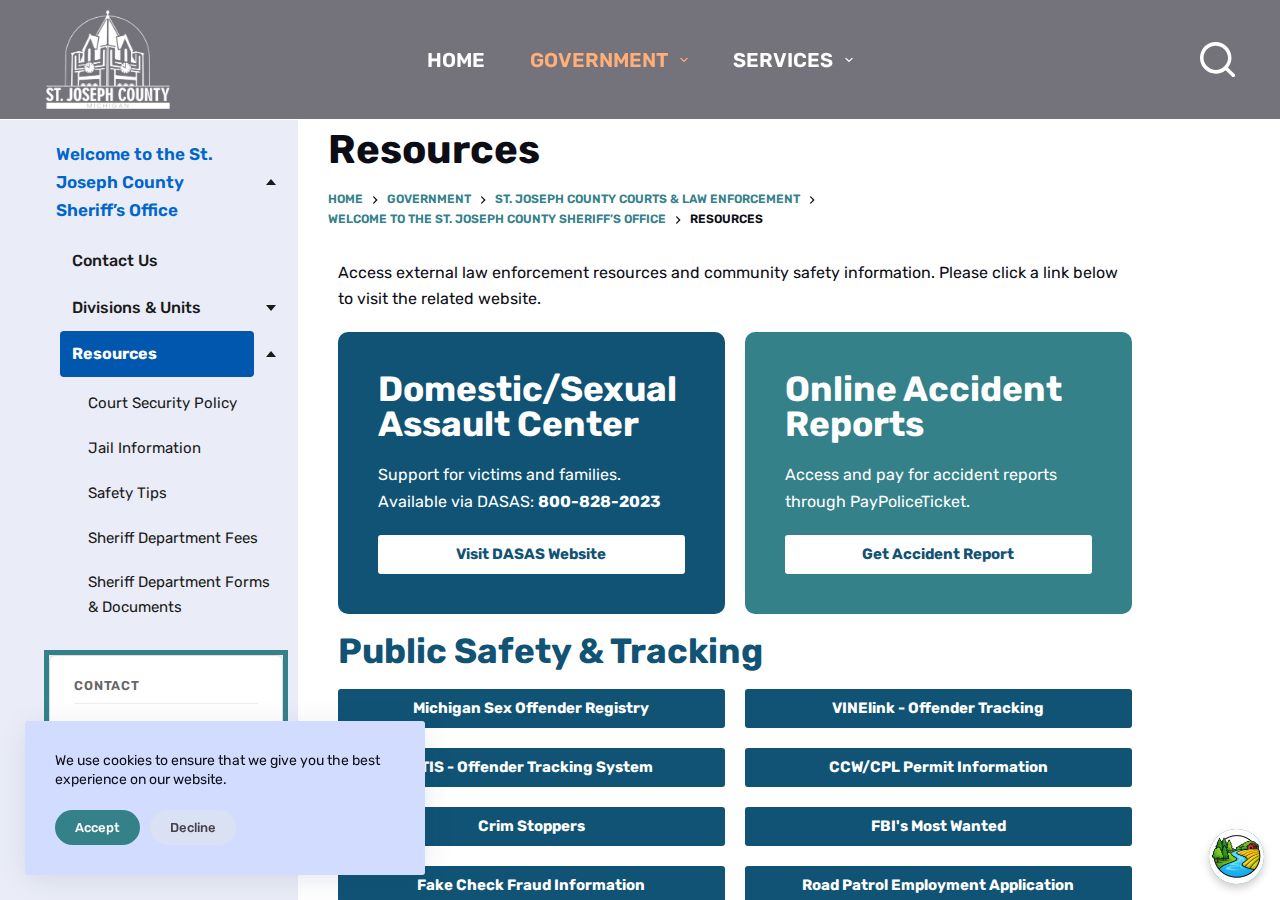
What that page does not include is a county warrant lookup. The links point outward to state and federal systems, none of which verify a local warrant.
Types of St. Joseph County Warrants and Holds
The word warrant covers several distinct orders. They differ in who asks for them, who signs them, and what triggers them. A person told they have a warrant should find out which type it is before doing anything else, because the fix is not the same.
| Type | What Triggers It |
|---|---|
| Arrest Warrant | A complaint and probable-cause review, or other criminal process. |
| Bench Warrant | A missed hearing, missed probation, contempt, or a broken court order. |
| Search Warrant | A sworn affidavit supporting a search; access to it may be restricted. |
| Traffic Warrant | Failure to appear or failure to pay on a citation. |
| Fugitive Warrant or Hold | Another jurisdiction seeks the person, sometimes with extradition. |
| Federal Detainer | A federal agency places a hold; the jail or agency must confirm it. |
Note: A bench warrant often follows something as ordinary as a missed court date, so it can surprise someone who never faced a new criminal charge.
How a Warrant Is Issued in St. Joseph County
Most criminal warrants here begin with a warrant request from police. The Prosecuting Attorney's Office reviews the police reports, witness statements, records, and the person's prior criminal or traffic history. That review decides whether a charge is authorized at all. If it is, a complaint is filed in the 3B District Court.
A magistrate then reviews the complaint, the warrant, and the affidavit establishing probable cause. Only after that review does an arrest warrant issue. The judicial check is the point of the process, and it is why a police request alone is not a warrant.
Bench warrants follow a different road. No prosecutor is involved. A judge issues one directly when a defendant fails to appear, ignores an order, or violates probation. The underlying case may be old and minor.
Warrant path: Police Report › Warrant Request › Prosecutor Review › Complaint Filed › Magistrate Probable-Cause Review › Warrant Issued
What a St. Joseph County Warrant Record Shows
Because no public warrant listing exists, no official field inventory could be captured from a county roster. The fields below come from how the county's court and prosecutor process actually works. They describe what a warrant-related court file may contain once the case reaches a court, not what a website displays.
- Case Number
- Identifies the criminal or traffic case the warrant belongs to.
- Defendant Name
- The person named in the complaint and warrant.
- Charge
- The offense the prosecutor authorized, or the order that was violated.
- Issuing Court
- The 3B District Court, or the 45th Circuit Court after bindover.
- Magistrate or Judge Action
- The probable-cause review and the signature authorizing the warrant.
- Bond and Arraignment
- Release conditions set once the person appears in court.
- Failure to Appear
- The event that commonly triggers a bench warrant.
A public case grid may show that a case exists and that a hearing was missed. The warrant itself usually does not appear as a searchable row.
Bench Warrants and Missed Court Dates
Traffic matters generate a large share of county bench warrants. Failure to appear or failure to pay can lead to default, added fees, a suspended license, and eventually an arrest warrant. The Traffic Division handles civil infractions and minor traffic misdemeanors, and its clerk can explain what a specific citation now requires.
Clearing a suspension takes longer than most people expect. The county warns that immediate clearances are not available when a license was suspended over an unpaid citation. Credit-card payments need 5 to 7 business days to process. Nobody may legally drive until the physical clearance card arrives in the mail from the court.
Paying the fine and clearing the warrant are therefore separate events on separate clocks.
Why ICHAT Does Not Show County Warrants
Michigan's statewide criminal history tool tempts people running a warrant check. It will not answer the question. Michigan State Police state directly that warrant information is not available through ICHAT, and that suppressed records are withheld as well. ICHAT reports reportable felony and serious misdemeanor convictions.
The practical consequence is easy to miss. A clean ICHAT result does not mean a person has no outstanding warrant in St. Joseph County. It means the system was never built to report one. The full charge and sentencing history behind a case lives in the county criminal court records instead.
How to Resolve an Outstanding Warrant
Acting early tends to help. An outstanding warrant does not expire on its own, and it can surface during an unrelated traffic stop. Court staff cannot give legal advice, so anyone facing real exposure should speak with counsel first. The sequence below reflects the county's own guidance.
- Do not rely on unofficial warrant sites. Start with the court that would hold the case.
- Call the 3B District Court for traffic, misdemeanor, and felony-initiation matters, or the 45th Circuit Court for a felony after bindover.
- Call the Sheriff's Office at (269) 467-9045 if custody, booking, or active enforcement may be involved.
- For a missed hearing or unpaid citation, ask the court about appearance, payment, bond, and clearance steps.
- Expect an arraignment and bond decision if charges were newly authorized, plus preliminary examination rights on a felony.
- Contact counsel or the public defender system if eligible, because court staff cannot advise on legal risk.
Someone already in custody on a warrant is handled through the jail, and the county inmate records page covers that process.
Crime Stoppers and Tip Channels
The sheriff's resource page links Crime Stoppers, and regional Crime Stoppers programs accept anonymous tips. Those channels serve investigators. They are not a warrant verification service, and a wanted listing circulated through a tip program carries no legal weight on its own.
Anyone acting on such a listing should confirm it with the court or the Sheriff's Office first. Approaching a person named in a tip is never appropriate. Reporting a location to law enforcement is.