
How to Search St. Joseph County Court Records
Court records in St. Joseph County are spread across several official channels, and no single database holds every file. The 45th Circuit Court, the 3B District Court, and the Probate Court each keep their own case systems and public counters. The official St. Joseph County website links to each court, the County Clerk, and the request tools that tie them together.
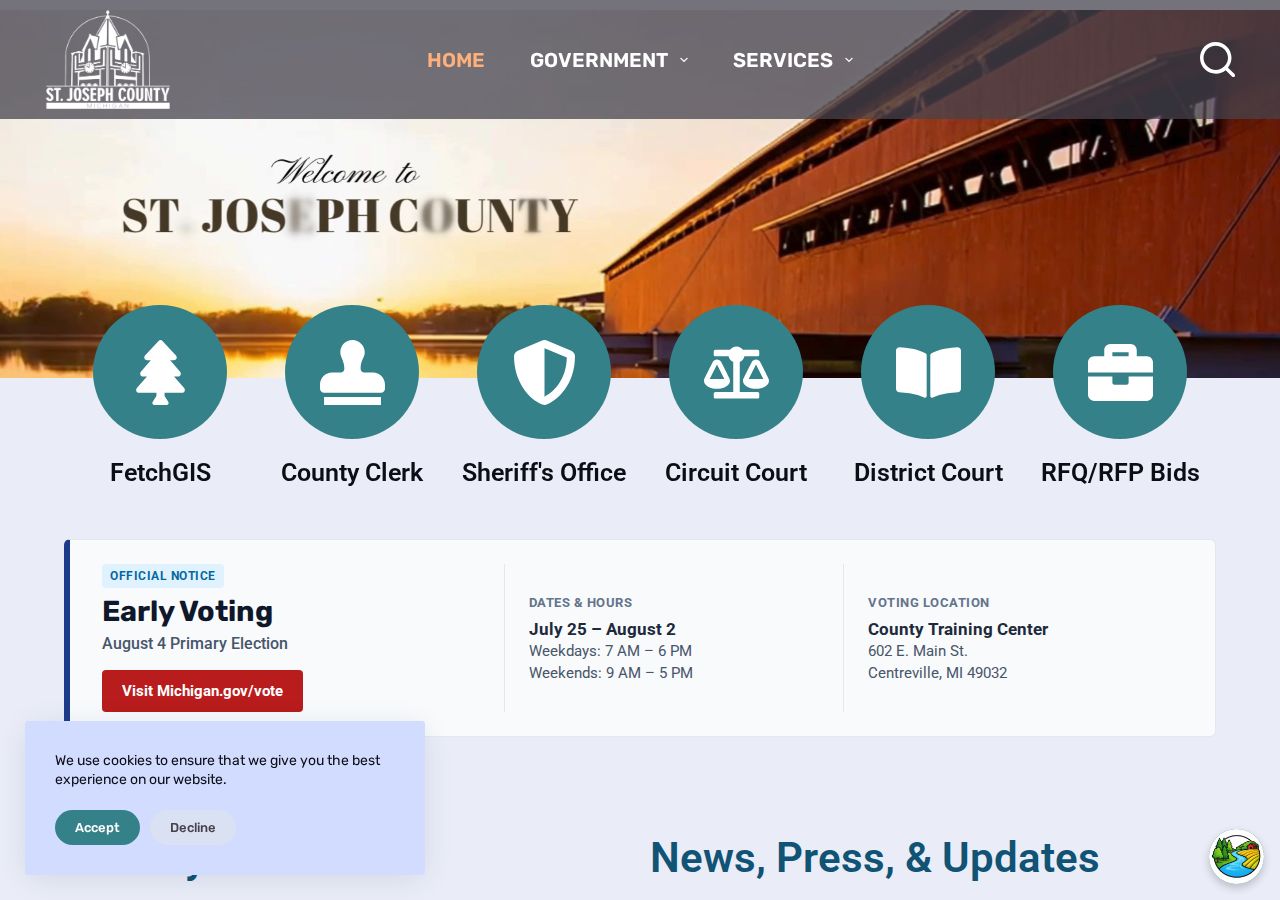
That county portal is the quickest way to reach the correct court page before a search begins. Most lookups start online and finish at a court counter when a certified copy or an older file is needed.
Before searching, gather a full name, a case number if you have one, and a sense of which court heard the matter. Circuit Court hears felonies after bindover along with larger civil and family cases. District Court starts every criminal case and handles most traffic and smaller civil claims. A short sequence covers the common public searches.
- Open the state MiCOURT case search and choose a court, or use the county's 45th Circuit Court route.
- For District Court, open the local 3B District Court case grid and filter by last name, first name, or case number.
- Narrow the results by case status, then check the District Court calendar for scheduled hearings.
- Read the register of actions to confirm charges, filings, and outcomes.
- Request a certified copy or a full file from the County Clerk or the court counter when court-admissible paper is required.
Note: Because of Michigan's Clean Slate law, online criminal viewing reflects cases from 2017 to the present, and older cases must be verified by hand.
The St. Joseph County Court System
Michigan runs three local trial courts, and St. Joseph County has all three. The 45th Circuit Court is the major trial court, handling felonies after bindover, larger civil claims, family and personal protection matters, and appeals from the lower courts. The 3B District Court is the limited-jurisdiction court where all criminal cases begin. The Probate Court handles estates, guardianships, and related matters from its office in Three Rivers.
The county lists Hon. Paul Stutesman as Circuit Judge, Robert Pattison as District Court Chief Judge, and Kevin Kane as Probate Judge, who also hears Family Division cases. The 45th Circuit Court page notes that its records reach back to the 1830s, a reminder that the online index is only part of the full paper history.
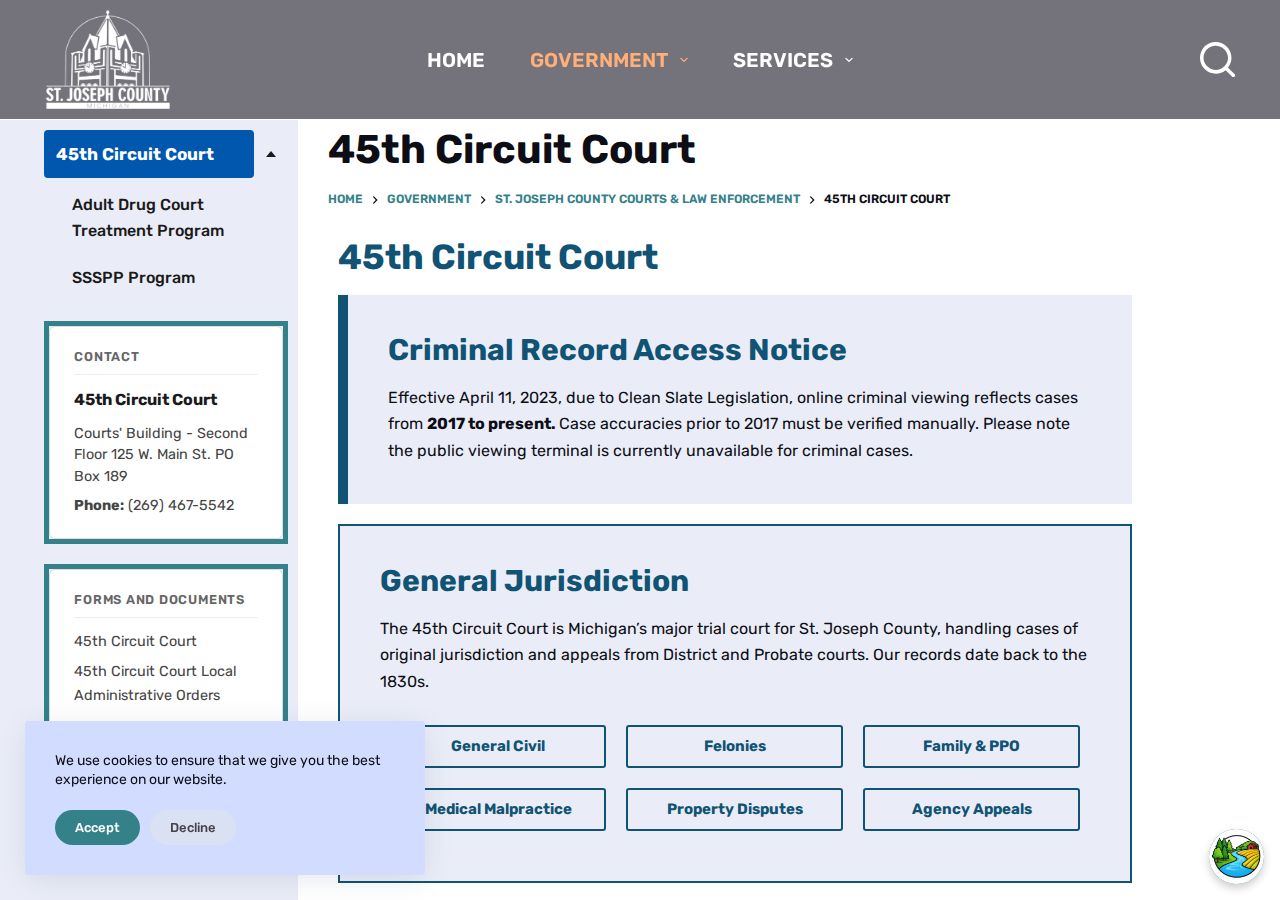
A criminal or civil dispute can move up through the system when a party appeals or when a felony is bound over.
Case flow: District Court › Circuit Court › Court of Appeals › Michigan Supreme Court
| Court | Jurisdiction | Case Types |
|---|---|---|
| 45th Circuit Court | General trial court | Felonies after bindover, larger civil, family, PPO, lower-court appeals |
| 3B District Court | Limited jurisdiction | Misdemeanors, felony start, traffic, civil up to $25,000, small claims |
| Probate Court | Probate jurisdiction | Estates, guardianships, conservatorships, trusts, adoptions, mental health |
| Court of Appeals | State appellate | Appeals from the county trial courts |
St. Joseph County Court Locations
Court services sit in two cities. The Historic Courthouse and Courts Building in Centreville holds the District Court and the County Clerk, while the Probate Court and Friend of the Court run from Three Rivers. During the current courts-building renovation, Circuit Court operations moved to the Three Rivers campus, so callers should confirm where a specific counter is open before a visit. The main courthouse address is used for mapping and mail.
Historic Courthouse / Courts Building
125 W. Main St.
Centreville, MI 49032
(269) 467-5500
45th Circuit Court
125 W. Main St., Second Floor
Centreville, MI 49032
(269) 467-5542
3B District Court
125 W. Main St., Main Floor
Centreville, MI 49032
(269) 467-5627
Circuit, District, and Probate Courts Compared
Choosing the right court is the single biggest time-saver in any records search. Michigan has no county court and no justice court, so nearly every local case lands in one of three courts. The dollar amount, the crime level, and the type of dispute decide which court holds the file.
The 3B District Court page confirms that every criminal case starts in District Court, even felonies that later move up. Small money disputes and landlord-tenant cases stay in District Court, while a divorce or a felony conviction file lives in Circuit Court.
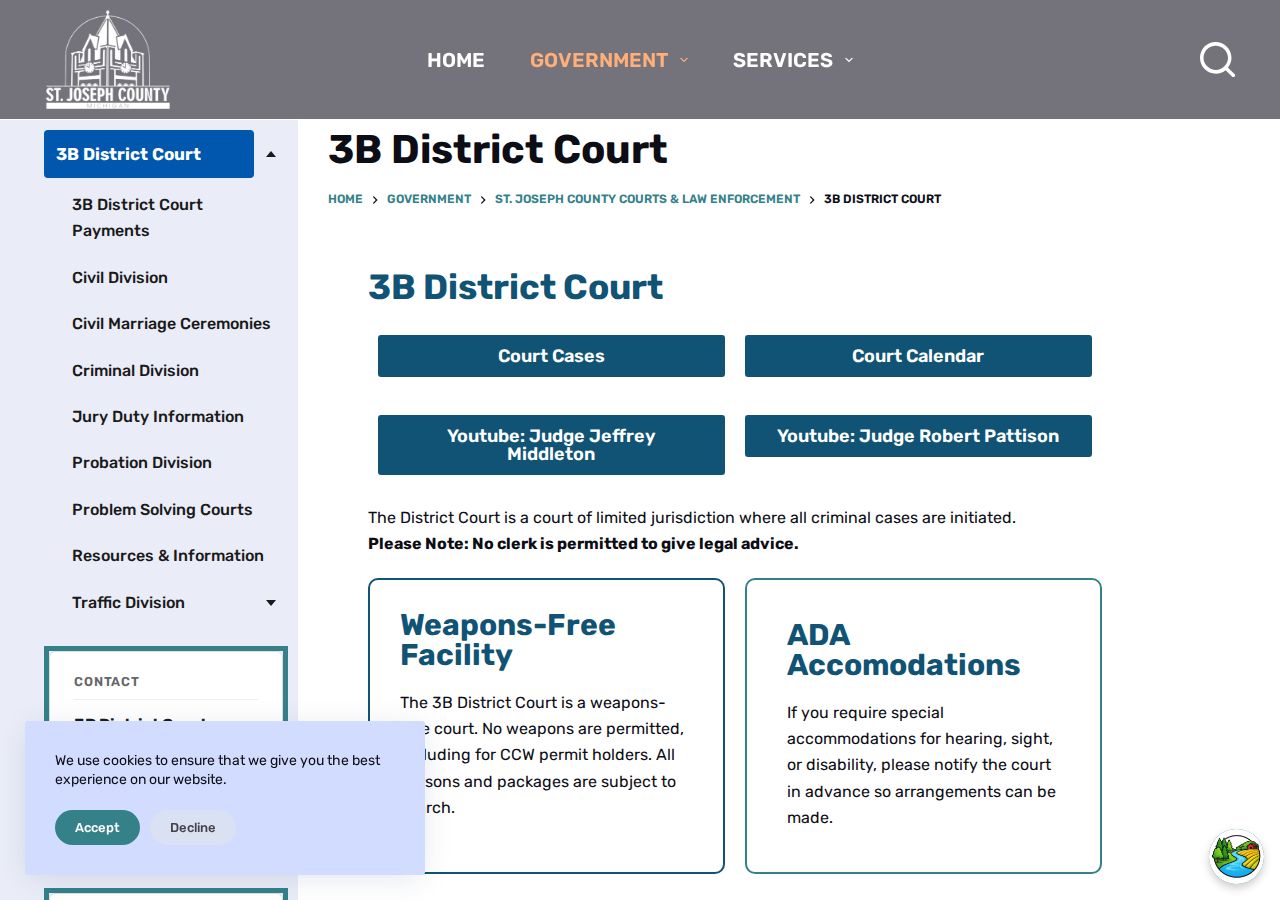
The table below sets the three courts side by side so a search points to the correct counter on the first try.
| Feature | 45th Circuit Court | 3B District Court | Probate Court |
|---|---|---|---|
| Civil reach | More than $25,000 | Up to $25,000; small claims up to $7,000 | Estates and guardianships |
| Criminal role | Felonies after bindover | All criminal starts; misdemeanors; felony preliminary stages | None |
| Other matters | Family, PPO, appeals | Traffic, landlord-tenant, land contracts | Trusts, adoptions, mental health, wills |
| Main location | Centreville courts building | Centreville courts building | Three Rivers |
Types of Court Records Available in St. Joseph County
The county's courts produce a wide range of public records. Where a record sits depends on the case type and the court that heard it. Civil files may be in either District or Circuit Court, criminal files begin in District Court, and family and probate matters split between Circuit and Probate Court.
Most case files can include complaints, motions, orders, judgments, and a register of actions that lists each event in order. Some categories carry access limits set by statute or court rule.
- Criminal records - Complaint, charges, arraignment, plea, disposition, and sentence, starting in District Court and moving to Circuit Court after bindover.
- Civil records - Complaints, answers, judgments, garnishments, and collection filings across District and Circuit Court.
- Family and divorce records - Divorce judgments, custody and support orders, and Friend of the Court administration.
- Probate records - Decedent estates, guardianships, and conservatorships, with adoptions and mental-health files kept confidential.
- Traffic records - Civil infractions and minor traffic misdemeanors handled by the District Court traffic division.
What St. Joseph County Court Records Show
A public search usually returns a case summary rather than full document images. The local District Court grid shows case numbers, party names, status, and attorneys, while the court calendar adds hearing dates and events. Michigan Court Rule 8.119 keeps document images off the internet, so the online index confirms a case while copies still come from a request.
The fields below appear across the county's online case tools. Case numbers use compact local formats such as 191617GC1 or 20872LT1, and only a birth year appears in the District grid rather than a full date of birth.
| Field | What It Shows |
|---|---|
| Case Number | The court's identifier, shown in compact formats in the District grid |
| Parties | Last and first names, or a business name |
| Case Status | OPEN or CLOSED in the District Court grid |
| Attorney | Listed where an attorney has appeared |
| Scheduled Event | Hearing type on the calendar, such as arraignment or pretrial |
| Disposition | The outcome once entered, such as a plea, dismissal, or sentence |
The statewide MiCOURT portal uses its own search form. Public date-of-birth searching may require approved state access, so most users search by name, case number, or court.
| Field | Type | Required | Notes |
|---|---|---|---|
| Court selection | Dropdown | Yes | 45th Circuit Court is linked as C45 |
| Case year | Number | Conditional | Four-digit year |
| Case number | Text | Conditional | Required for a case-number search |
| Last name | Text | Optional | Used in a name search |
| Date of birth | Date | Restricted | May need approved SCAO access |
| Case category | Dropdown | Optional | Civil, criminal or traffic, probate, family |
Public Access Laws for St. Joseph County Court Records
Michigan court sittings are open to the public, and case files are presumed public unless a statute or court order limits them. A key twist sets Michigan apart from many states. Court records are not Freedom of Information Act records, because the state FOIA excludes the judiciary, including the County Clerk when acting as clerk of the Circuit Court. Case files come through court rules and copy requests, while FOIA covers non-court county records.
Access begins with the open-court statute, which keeps court sittings public except as the law provides. The rules and statutes below shape how records are viewed and copied.
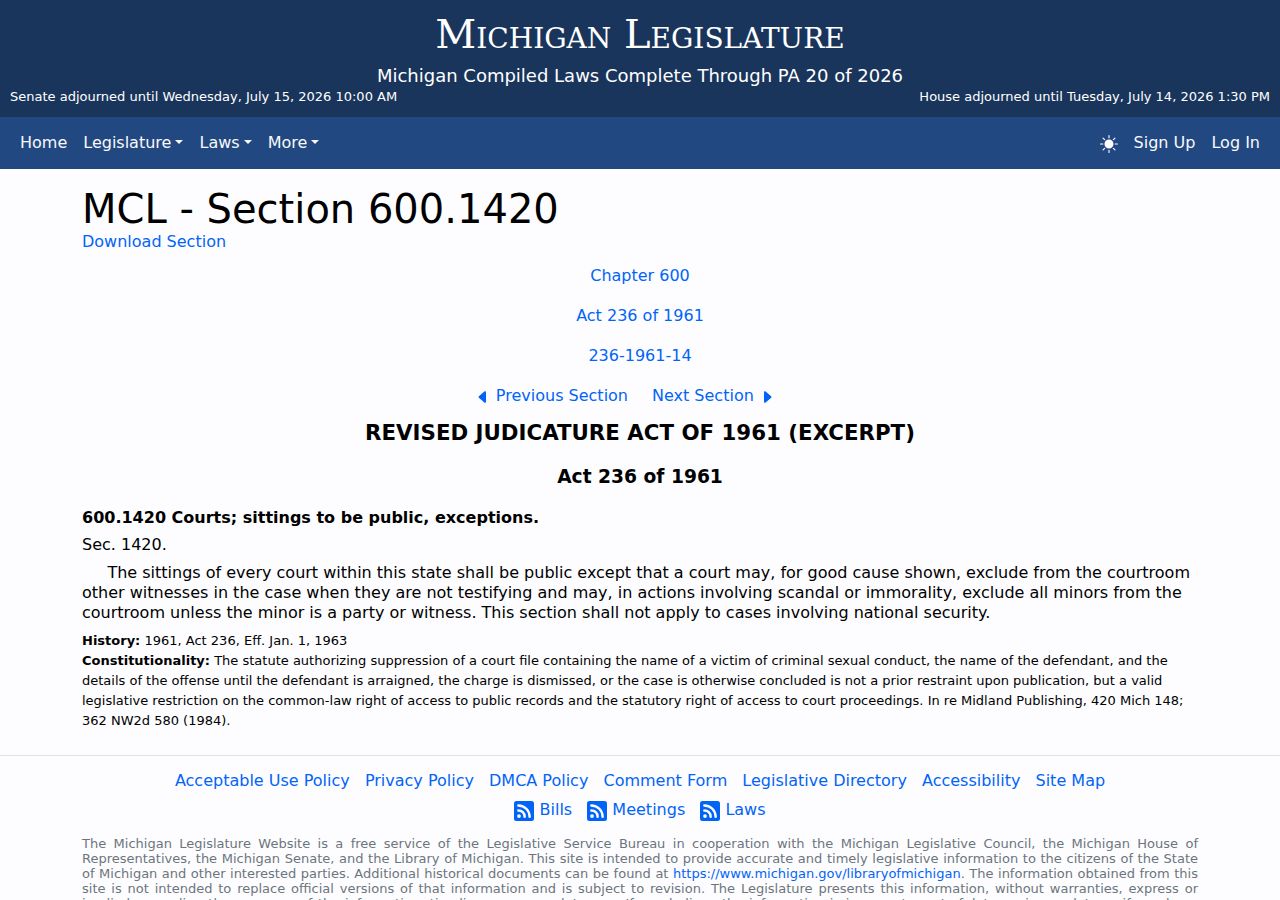
A few core sources carry most of the weight for anyone requesting records.
Key Statutes and Rules:
MCL 600.1420 - Michigan court sittings are public except as otherwise provided by law.
MCR 8.119 - Governs custody and public access to court records; online access does not put every document image online.
MCL 15.231 - Michigan FOIA favors access to public-body records, but court files run under court rules instead.
MCL 780.621 - Sets the framework for setting aside convictions, one legal source behind Clean Slate limits.
Records That Are Restricted or Confidential
Some records stay out of ordinary public view. Juvenile files, adoption files, and mental-health proceedings are confidential under Michigan law and court rule. The Probate Court FAQ treats decedent estates, guardianships, and conservatorships as public, while adoptions and mentally ill files stay closed. Wills are confidential until the person who made the will has died.
Set-aside law adds another layer. Once a conviction is set aside under Michigan's expungement framework, the public case view may be restricted, though law enforcement keeps limited access. The county's Clean Slate notice warns that online criminal viewing reflects only 2017 to the present, so older or cleared records need manual verification at the court.
Important: The public viewing terminal for criminal cases is listed as currently unavailable, so older criminal records should be confirmed directly with the court rather than assumed complete online.
Specialty Courts in St. Joseph County
The county runs problem-solving courts that focus on treatment and recovery rather than routine punishment. Two programs anchor this work, one in Circuit Court and one in District Court. Both use a team approach that brings judges, probation, prosecutors, law enforcement, and treatment providers to the same table.
The 45th Circuit Court operates an Adult Drug Court Treatment Program supported by state and federal grants. It is a five-phase intensive program aimed at the root causes of criminal behavior, with weekly team meetings, weekly court sessions, and continuous progress review.
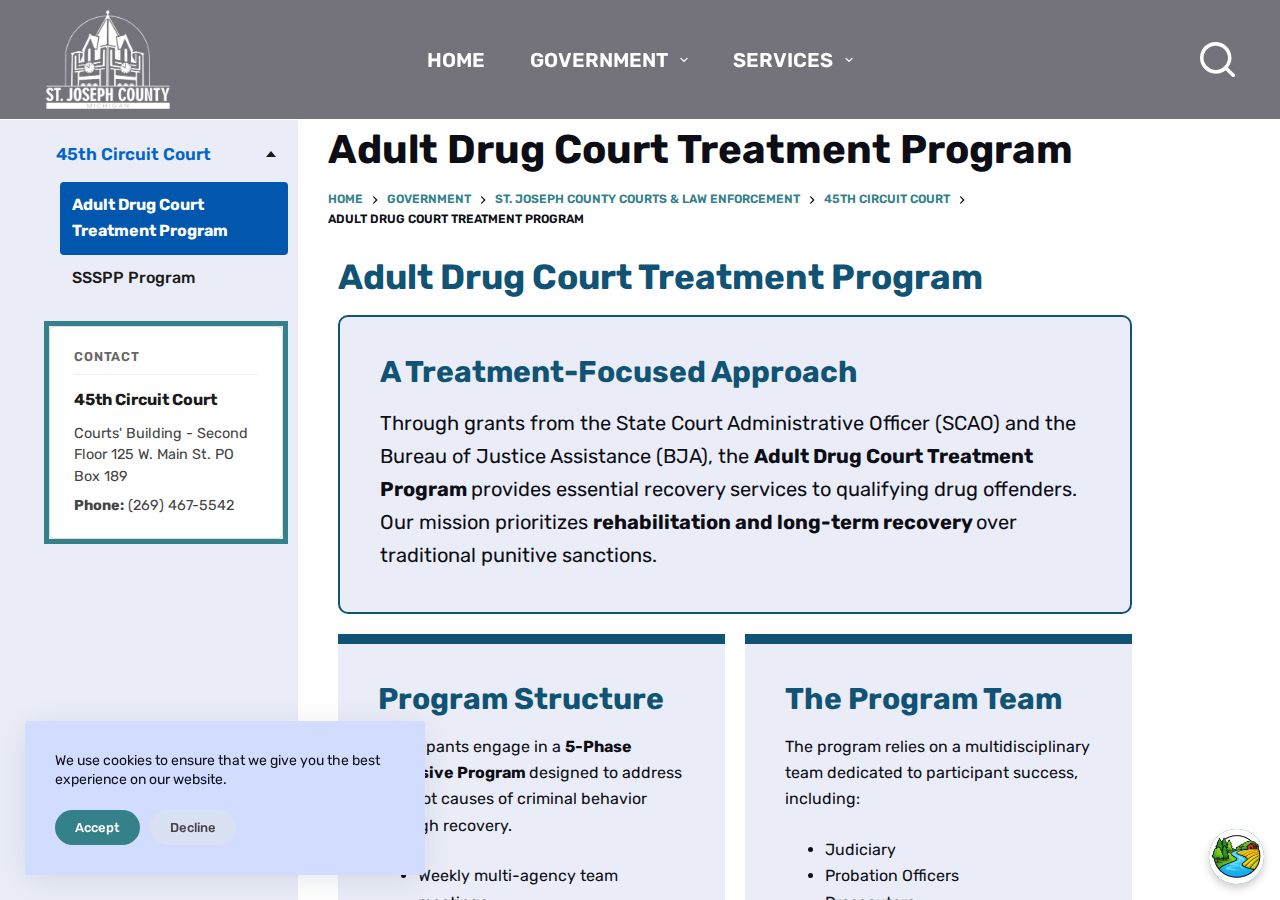
Eligibility depends on legal and clinical criteria, so the court screens each candidate before entry.
The 3B District Court runs a Sobriety Court for repeat drunk drivers. Its goal is to cut repeat offenses through intensive supervision, individualized treatment, personal accountability, and frequent judicial review.
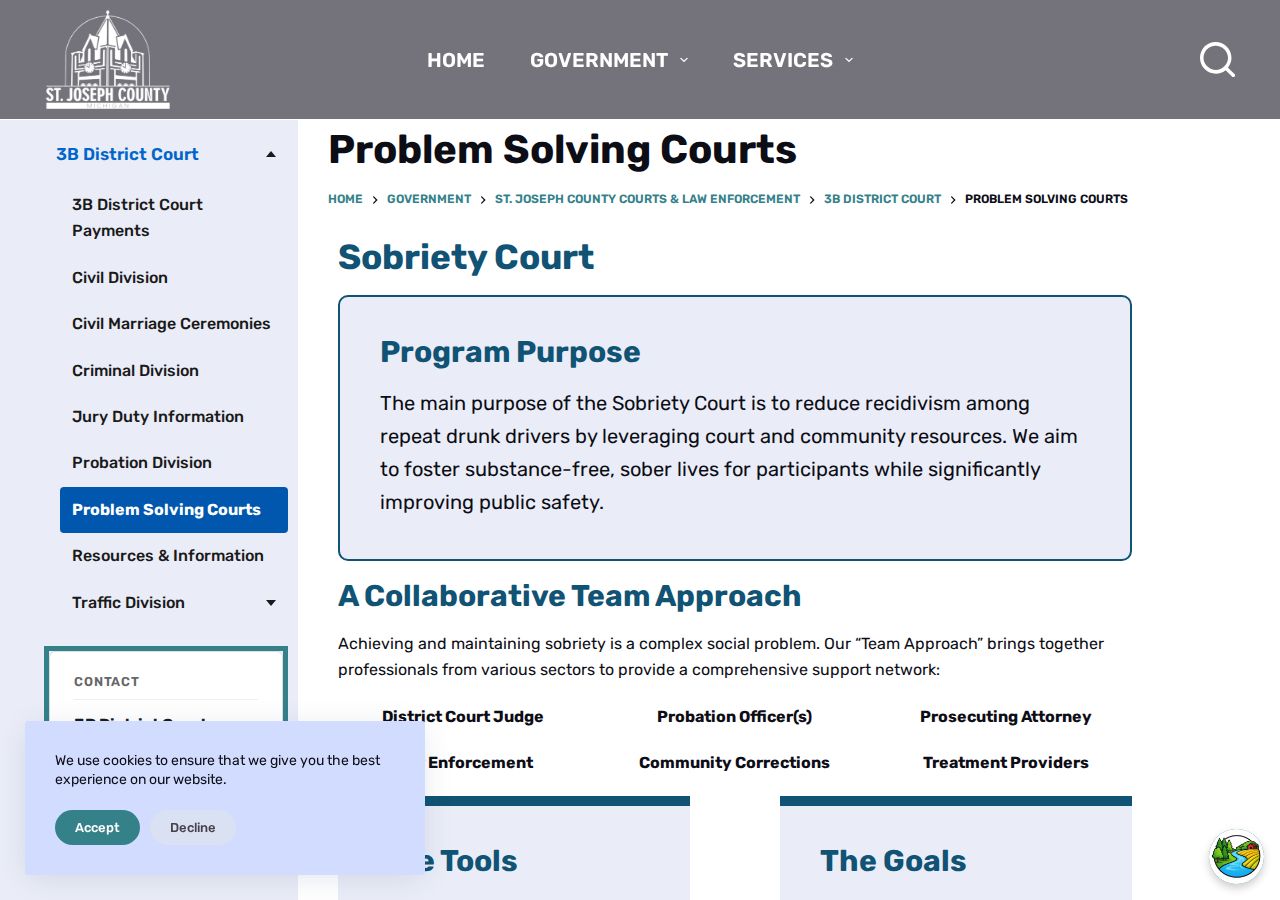
The county directs interested people to the Probation Division. An official county-hosted document also references a developing Juvenile Mental Health Court, a sign that specialty programming continues to grow.
St. Joseph County Sheriff and Jail
The St. Joseph County Sheriff's Office runs county law enforcement and the county jail. Sheriff Chad Spence leads the office, which the county describes as a peace-officer agency under Michigan law. The jail operates around the clock and holds people arrested locally, defendants held before trial, and some serving short sentences.
No official public jail roster is posted on the county website, so custody status is confirmed by phone or through statewide notification tools. The Sheriff's Office answers custody and booking questions at (269) 467-9045. For a full look at how to check custody, the county's inmate records page walks through the VINE notification service, the state OTIS system, and jail contact steps. Active-warrant questions run through the District Court and the Sheriff's Office, since no county warrant database is published online.
St. Joseph County Marriage, Divorce, and Probate Records
Marriage licenses and certified marriage copies come from the County Clerk, and county marriage records reach back to 1832. Divorce case files are Circuit Court and Family Division records kept by the County Clerk, while the state also holds certified divorce records dating to 1897. Probate files cover estates, guardianships, and conservatorships from the Three Rivers office. A closer walkthrough of application steps, fees, and certified copies sits on the county's marriage and divorce records page.
Probate matters use terms that trip up many first-time filers. A short glossary clears the most common ones.
- Testator
- A person who makes a will.
- Executor
- The person named to carry out a will, called a personal representative in Michigan.
- Conservator
- Someone the Probate Court appoints to manage another person's finances.
- Guardian
- Someone appointed to make personal-care decisions for another person.
- Intestate
- Dying without a valid will, which sets estate distribution by law.
St. Joseph County Court Records Fees
The County Clerk and the courts charge set fees for copies of court files. The local administrative order lists per-page copy rates and timing, along with separate rates for transcripts and recordings. Small copy jobs are usually handled quickly, while larger jobs take a reasonable time to prepare.
The fees below apply to court-record copies at the County Clerk and the court counters. Payment methods can vary by office, so confirm accepted forms before a visit.
| Item | Amount |
|---|---|
| 10 or fewer pages | $1.00 per page, usually within 1 hour |
| More than 10 pages | $1.00 per page, provided in a reasonable time |
| Transcripts filed with the court | Up to $0.30 per page |
| Court recording on DVD | $20 per DVD |
| State-approved court forms | $1.00 per form, up to 5 copies per type |
Reading St. Joseph County Court Records
Case files use shorthand that can confuse a first-time reader. A charge is only an accusation, while a conviction is a proven or admitted result, so a filed charge does not mean a person was found guilty. Case-number suffixes hint at the case type, and visible codes in the District grid include GC for general civil, LT for landlord-tenant, and SP for small claims, though the county publishes no full decoding glossary.
The register of actions lists each event in date order, from filing to disposition. A disposition entry shows how a charge or case ended, such as a plea, a dismissal, or a sentence. When a file shows an open status but no recent activity, a call to the court counter is the fastest way to confirm the current stage.
Visiting the St. Joseph County Courthouse
The Centreville Courts Building is in the middle of its first major renovation in more than 50 years. The county reports an approximate $12.4 million project, financed in part by $5 million in bonds at about 3.52 percent interest, with no tax increase. The work adds a single secure entry, a secure sallyport, updated fire and life-safety systems, elevator modernization, and reconfigured courtrooms and offices.
The official renovation notice lists temporary moves that matter to records users. District Court sits on the Historic Courthouse third floor, the Prosecutor's Office on the first and second floors, and County Clerk Elections on the second floor.
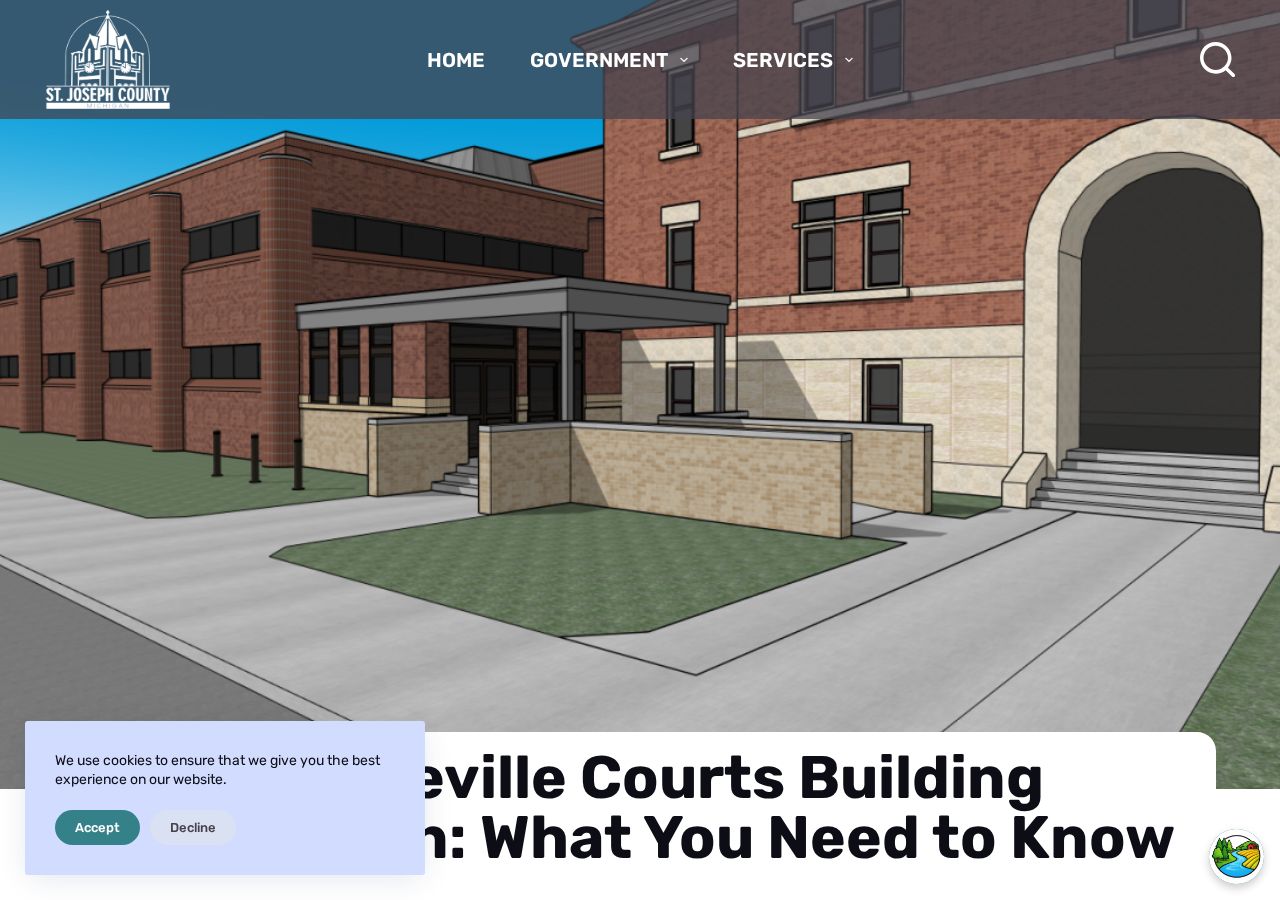
Circuit Court operations moved to the Three Rivers campus during construction, while the Public Defender and District Court Probation moved to the Annex Building on South Dean Street. Anyone visiting a counter should confirm the current location by phone first, since the project runs up to 18 months.
History of St. Joseph County Courts
Court records in the county run deep. The 45th Circuit Court reports that its records date back to the 1830s, which places the court among the region's oldest continuous public offices. Centreville has long served as the county seat, and the government campus grew over time to include the courts building, annexes, and the Sheriff's Office.
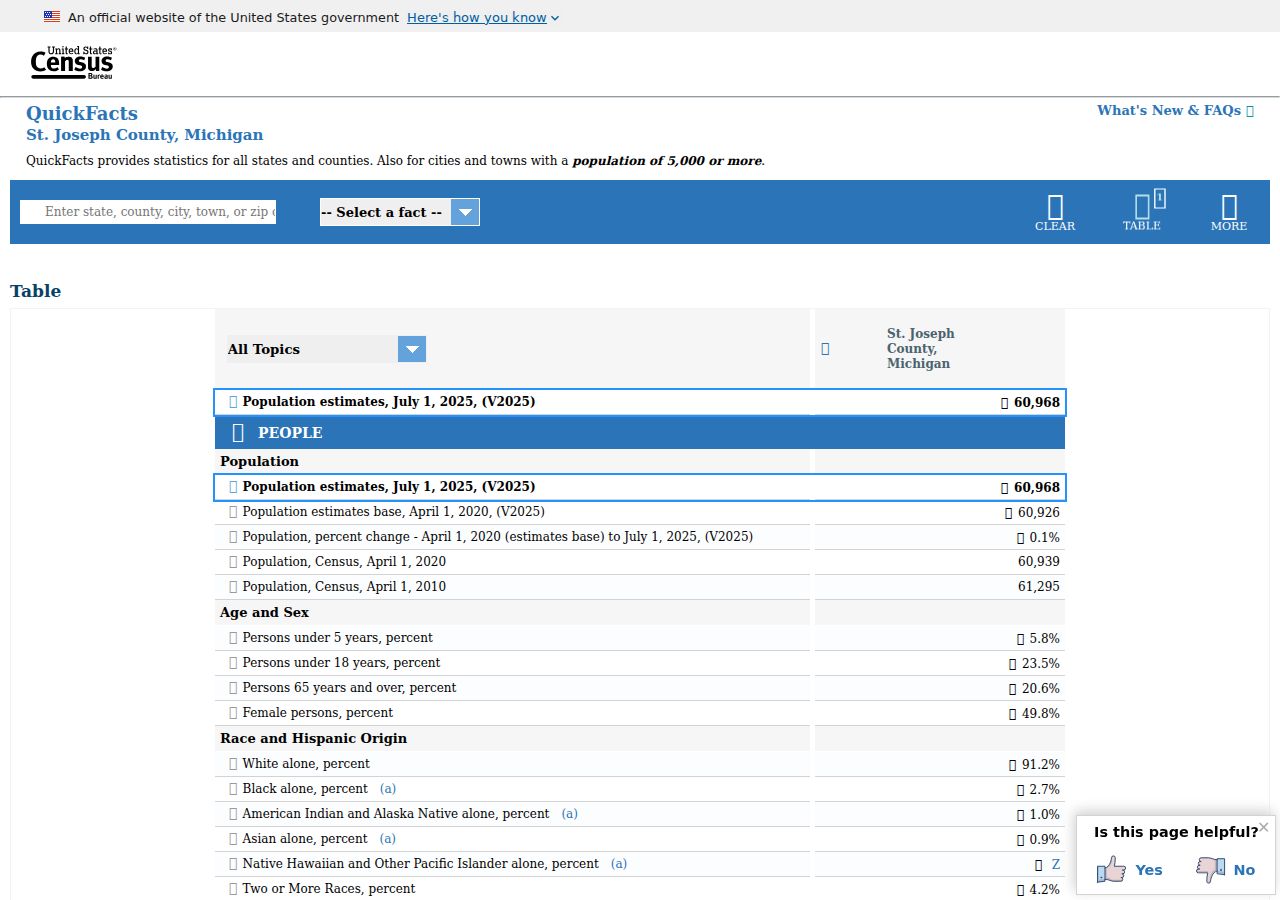
The county's population and demographics shape how busy those courts stay today. Census figures for the county describe a mix of rural townships and small cities across southern Michigan, near the Indiana line.
Population and community context for the county appear in the U.S. Census QuickFacts profile.
That long record history is also why online tools tell only part of the story. Files from the 1800s and much of the 1900s live in paper form and require a court request to view.
Frequently Asked Questions
Are St. Joseph County court records public?
Most court records are public in Michigan. Court sittings are open, and case files are presumed public unless a statute or court order restricts them. Categories such as juvenile, adoption, and mental-health files stay confidential. Court records are not FOIA records, so access runs through court rules and copy requests rather than the state open-records act.
Why do older criminal cases not appear online?
The county's Clean Slate notice explains that online criminal viewing reflects cases from 2017 to the present. Accuracy for cases before 2017 must be verified by hand at the court. The public viewing terminal for criminal cases is also listed as currently unavailable, so older criminal records are confirmed directly with court staff.
Can I download case documents online?
No. Michigan Court Rule 8.119 keeps document images off the internet. The online index confirms a case, its status, and its docket events, but copies of pleadings, orders, transcripts, and recordings require a request. Copies come from the County Clerk or the court counter, with per-page fees set by local order.
Which court do I search for a felony?
Every criminal case begins in the 3B District Court, where arraignment, bond, and the preliminary examination take place. If the court finds probable cause, the felony is bound over to the 45th Circuit Court, where the trial file lives. Search District Court for the early stages and Circuit Court for the later record.
Does the county post a jail roster online?
No official public jail roster appears on the county website. To confirm custody, call the Sheriff's Office at (269) 467-9045 or use the statewide VINE notification service. The state OTIS system covers prison, parole, and probation but not county jail bookings, so it is not a substitute for a jail call.
Where are marriage and divorce records kept?
The County Clerk issues marriage licenses and certified marriage copies, with county records dating to 1832. Divorce files are Circuit Court and Family Division records kept by the same clerk office. The Michigan Department of Health and Human Services also provides certified statewide marriage and divorce copies, with divorce records back to 1897.
What does a certified copy cost?
Court-record copies run $1.00 per page for jobs of 10 or fewer pages, usually within an hour. Larger jobs stay at $1.00 per page but take a reasonable time. Court recordings are $20 per DVD, and transcripts filed with the court run up to $0.30 per page. Confirm accepted payment methods with the office first.