
Which Court Handles St. Joseph County Traffic Cases
The 3B District Court handles traffic in St. Joseph County. Its Traffic Division takes civil infractions and minor traffic misdemeanor offenses. No separate municipal traffic court operates here, so drivers do not have to guess which of several courts holds a citation. Drivers may pay preset fines daily. They may also schedule an informal hearing with the Traffic Clerk, which must be arranged in advance.
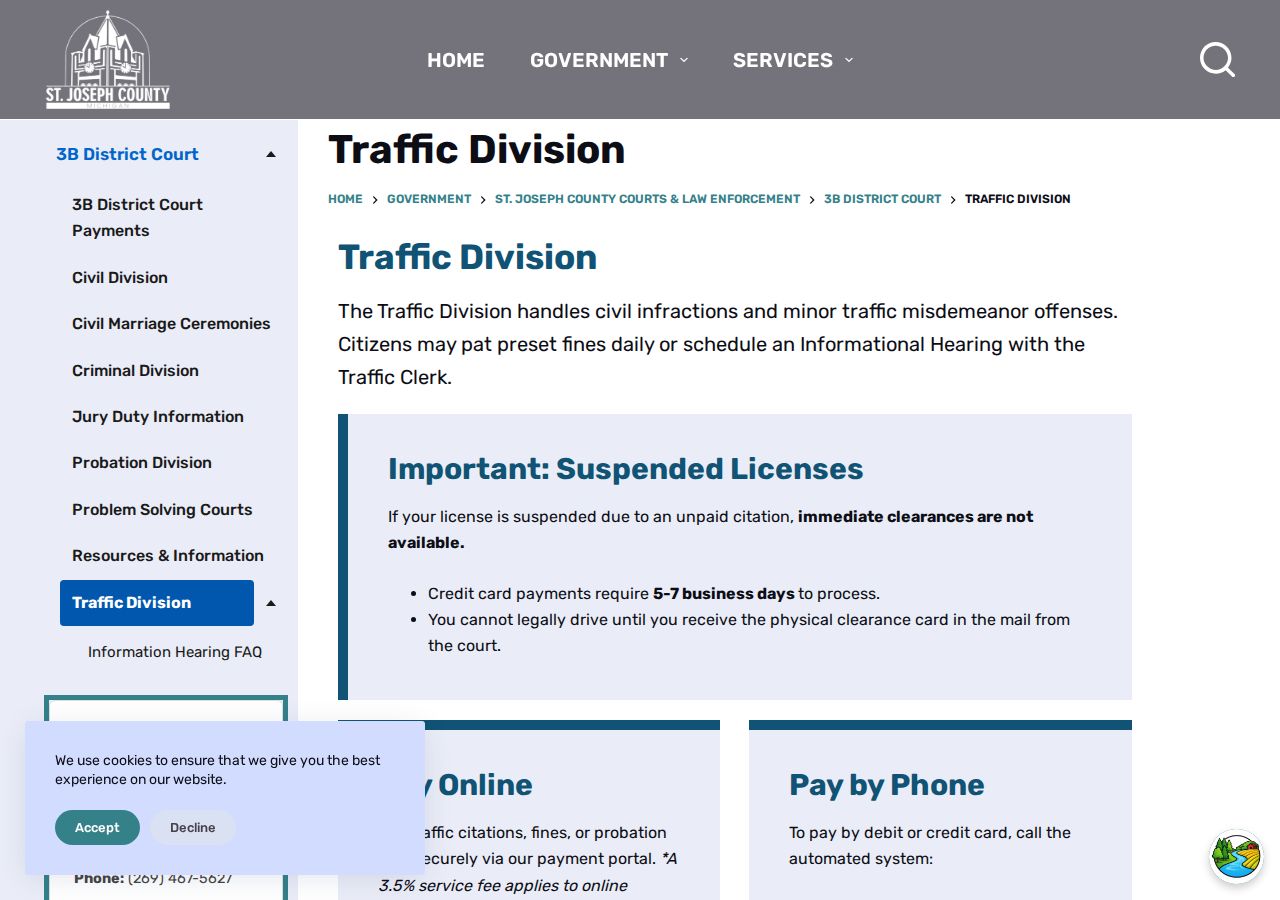
The county's Traffic Division page carries the payment instructions and the warning about suspended licenses.
Serious offenses leave that division entirely. A felony traffic matter starts in District Court and then moves to the 45th Circuit Court after bindover.
3B District Court Traffic Division
Courts' Building
125 W. Main St., P.O. Box 67
Centreville, MI 49032
(269) 467-5503
Monday to Friday, 8:00 AM to 5:00 PM
How to Search St. Joseph County Traffic Court Records
Traffic cases appear inside the District Court's public case grid. The grid is not traffic-only, so a search returns civil and criminal matters alongside citations. Rather than a single search form, it places a filter box beneath each column. Filters offer Contains, Starts With, Ends With, and Equal To.
A citation number is the fastest way in. A name search works when the number is lost, though common surnames force extra filtering. Birth year helps separate two drivers who share a name, and the grid never exposes a full date of birth.
| Field Label | Type | Required | Notes / Format |
|---|---|---|---|
| Case # | Column filter text | Optional | Local compact case-number formats. |
| Last Name | Column filter text | Optional | Contains, Starts With, Ends With, Equal To. |
| First Name | Column filter text | Optional | Same filter controls. |
| Birth Year | Column filter number | Optional | Year only; distinguishes drivers with the same name. |
| Status | Column filter text | Optional | OPEN or CLOSED. |
| Attorney | Column filter text | Optional | Shown where an attorney appears. |
| Page size | Dropdown | Optional | 10, 20, or 50 rows. |
Note: The grid confirms a case and its status, yet it does not post citation images or the signed orders behind a disposition.
Types of St. Joseph County Traffic Cases
Michigan splits traffic matters into two tracks, and the split governs everything that follows. A civil infraction is not a crime. It carries a fine and possible points, but no jail and no criminal record. A traffic misdemeanor is a crime, and it can bring jail, probation, and a criminal record that follows a person for years.
The 3B District Court also hears conservation, watercraft, liquor, and animal violations alongside its traffic docket. Those share the same limited-jurisdiction counter.
- Civil infractions: speeding, disobeying a signal, expired registration, seat belt violations.
- Minor traffic misdemeanors: offenses carrying possible jail, handled in District Court.
- Serious traffic crimes: felony matters that bind over to the 45th Circuit Court.
- Equipment violations: defective equipment, often correctable with proof.
Drunk driving sits in the criminal track rather than the infraction track, and it is covered further below.
What St. Joseph County Traffic Records Show
A traffic court file records what the court did about a citation. It does not record what the state did to a license. Reading it in that light prevents most confusion about points and suspensions.
- Citation or Case Number
- Identifies the ticket within the District Court system.
- Charge
- The violation as written, such as speeding or disobeying a signal.
- Court Date
- Any scheduled hearing, including an informal hearing.
- Hearing Result
- What the court decided, including a dismissal.
- Default or Failure to Appear
- Entered when a driver misses a date or a payment.
- Fines and Costs
- The amount assessed and the payment history.
- Disposition
- The final outcome of the citation.
Points never appear as a court finding. The court lists them only as a courtesy, because the state assigns them.
St. Joseph County Traffic Fines and Points
The court publishes preset fines for common violations. Paying a preset fine ends the case without a hearing, and it counts as a decision not to contest. Points shown beside each fine are informational. The court cannot waive them, add them, or negotiate them, because the Secretary of State controls the point system entirely.
| Violation | Fine / Cost | Points |
|---|---|---|
| Speeding 1 to 10 over | $90 | 2 |
| Speeding 11 to 15 over | $110 | 3 |
| Speeding 16 to 20 over | $140 | 4 |
| Speeding 21 to 25 over | $150 | 4 |
| Speeding 26 to 30 over | $160 | 4 |
| Disobey signal or stop sign | $120 | 3 |
| Expired registration | $120 | 0 |
| Seat belt | $65 | 0 |
| Child restraint | $95 | 0 |
| Defective equipment | $105 | 0, waived with valid proof shown within 21 calendar days |
| School or construction zone speed | Call the court | Varies |
Defective equipment is the one line that rewards a quick fix. Showing valid proof of repair to the court within 21 calendar days waives the points.
Paying or Contesting a St. Joseph County Ticket
Three payment channels exist, and each carries its own cost and timing. Online payment is convenient but adds a service fee of 3.5 percent. Phone payment runs through an automated system. In-person payment at the Courts' Building accepts the widest range of methods, including cash, money order, certified check, and credit card.
Contesting a citation means asking for an informal hearing with the Traffic Clerk, scheduled ahead of time rather than walked in.
- Read the citation and identify whether it is a civil infraction or a traffic misdemeanor.
- Contact the Traffic Division at (269) 467-5503 for case status, hearing date, or the amount due.
- To pay a preset fine, use the online portal, the automated phone line at (888) 604-7888 with Pay Location Code 1589, or pay in person.
- Budget for the 3.5 percent service fee if paying online.
- To contest, schedule an informal hearing with the Traffic Clerk in advance.
- Never assume payment instantly clears a license suspension.
In-person payments are taken at the Courts' Building, First Floor, 125 W. Main St., Monday through Friday, 8 AM to 5 PM.
Suspended Licenses and Clearance Delays
This is where drivers get caught. Paying an old ticket does not restore driving privileges the same day. The county states that immediate clearances are not available when a license was suspended over an unpaid citation. Credit-card payments take 5 to 7 business days to process.
Until the physical clearance card arrives in the mail from the court, driving remains unlawful. A receipt is not a license.
Do not drive on a paid receipt: A St. Joseph County suspension over an unpaid citation clears only after processing, and legal driving resumes when the physical clearance card arrives by mail.
Court Traffic Records Versus State Driver Records
Two files follow every Michigan ticket. The court traffic record belongs to the 3B District Court. The driving record belongs to the Secretary of State. They serve different readers, hold different data, and are corrected in different places. Asking the court to remove points, or asking the state about a hearing date, wastes a call.
| Court Traffic Record | State Driver Record | |
|---|---|---|
| Kept by | 3B District Court | Michigan Secretary of State |
| What it holds | Citation, charge, hearings, defaults, fines, disposition | License status, points, suspensions, certified driving history |
| Where to access | District Court case grid or the court counter | Secretary of State driving-record service |
| How to fix an error | Contact the Traffic Division | Contact the Secretary of State |
The state explains its own service on the Secretary of State driving-record page.
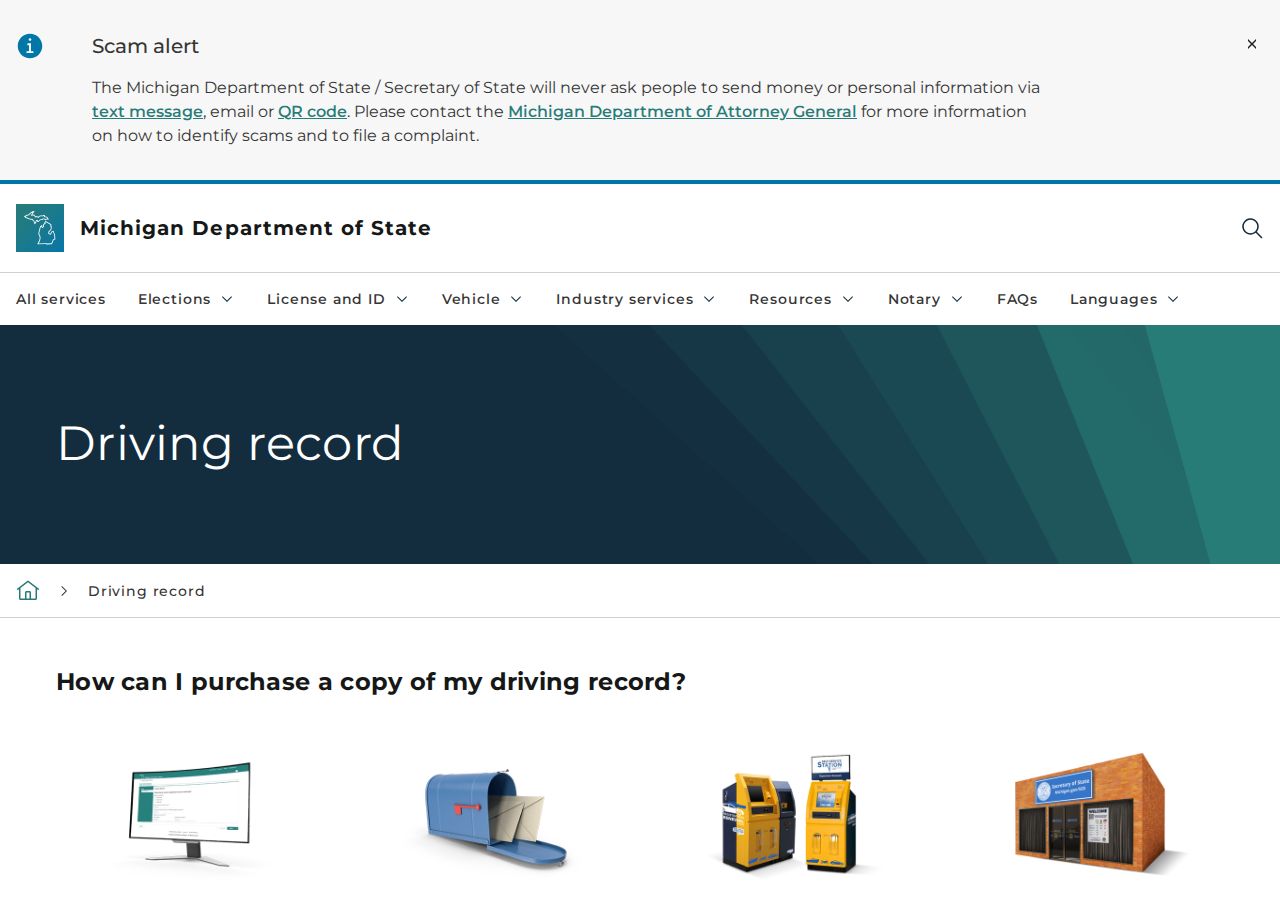
Records bought in a Secretary of State office are certified. Online certified copies require a MiLogin account and identity verification. The county's administrative order also directs driving-record requests to the Michigan Department of State Commercial Look-up Unit, 7064 Crowner Drive, Lansing, MI 48918, reachable at (517) 322-1624. The Secretary of State call center answers at (888) 767-6424.
CDL Rules and Driver Record Privacy
Commercial drivers carry extra exposure. A citation that a private driver might pay and forget can threaten a commercial license, because the underlying conviction reaches the state driving record either way. Paying a preset fine is an admission of responsibility, not a way to keep a violation off that record.
Access to another person's driving record is also restricted. Federal privacy limits govern who may obtain one and why.
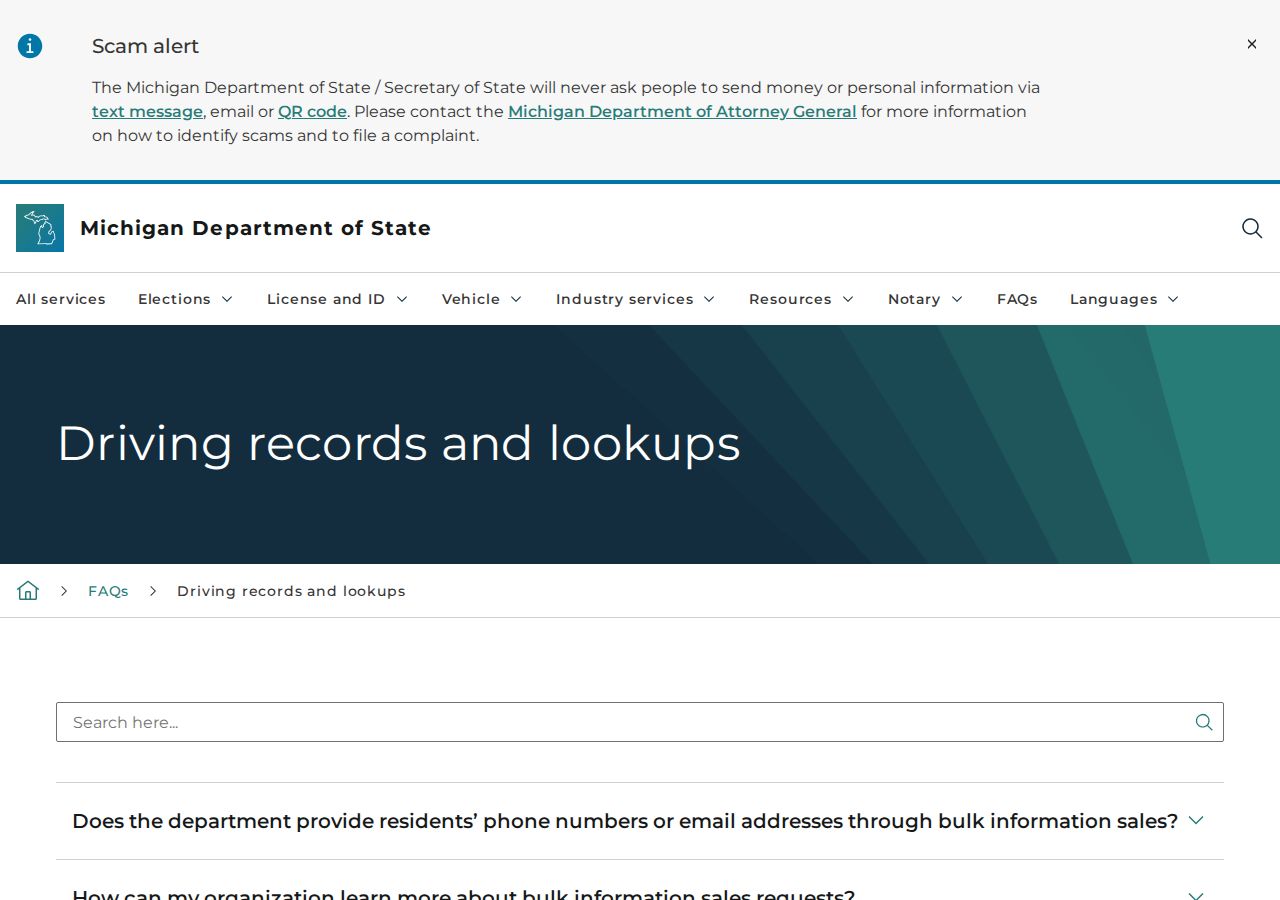
Those limits are described in the state's driver and vehicle record FAQ.
A commercial driver facing a citation should weigh a hearing before paying, since the court cannot undo a point once the state records it.
Drunk Driving Cases and Sobriety Court
Operating while intoxicated is a criminal charge, not a civil infraction. It begins in the 3B District Court like every other criminal case in the county. A felony version binds over to the 45th Circuit Court, and the full case file with pleas and sentencing appears in the county criminal court records.
The District Court also runs a Sobriety Court for repeat drunk drivers. The county describes it as a team effort involving the judge, probation officers, the prosecuting attorney, law enforcement, Community Corrections, and treatment providers. Intensive supervision, individualized treatment, personal accountability, and frequent judicial review are its tools. Its stated goals are safer roads, long-term sobriety, and fewer repeat offenses. Participation is limited to selected people who meet the criteria, and the Probation Division screens candidates.